


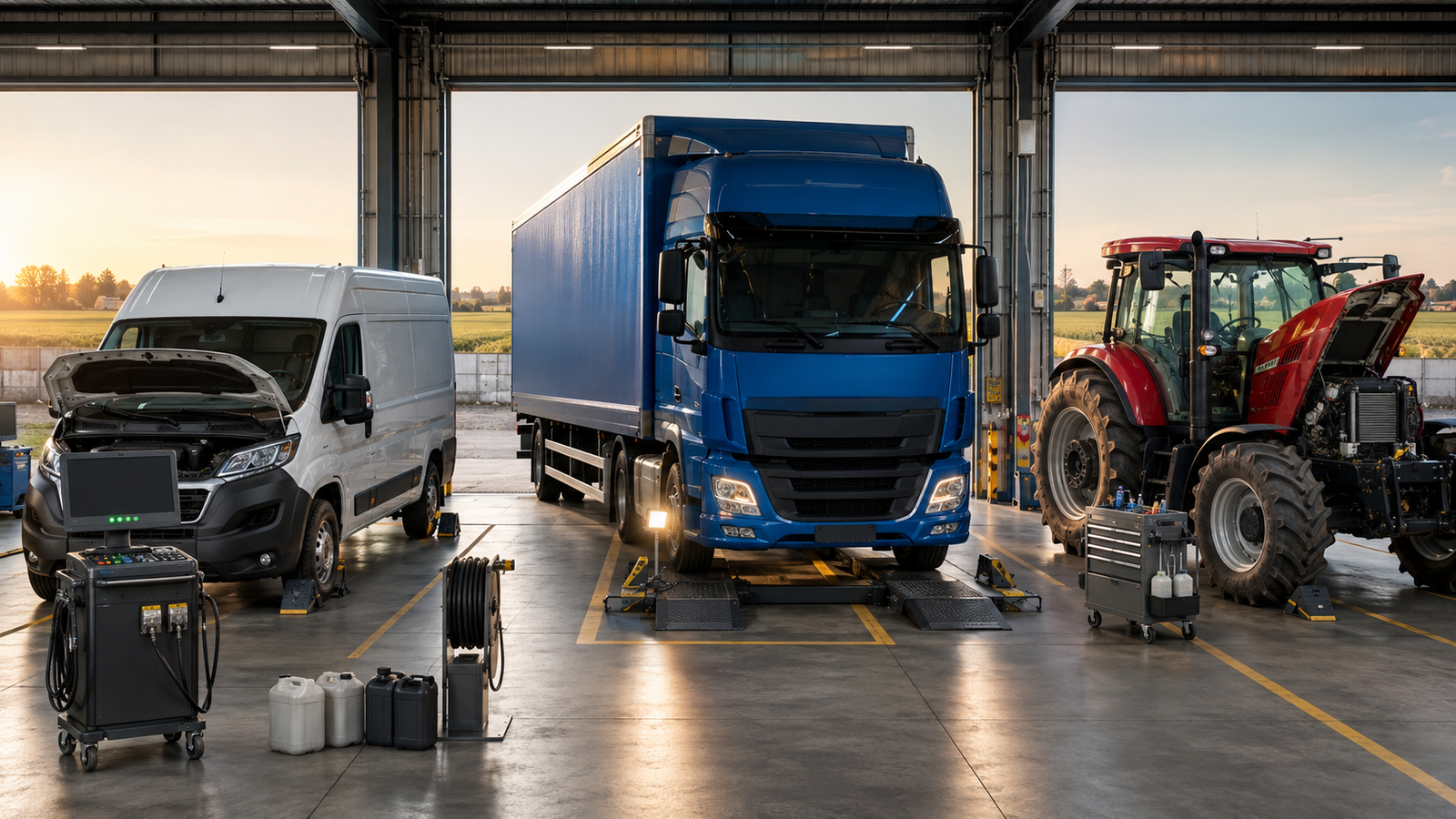
When a passenger car remains immobilized for a few days, the situation is above all restrictive. With a professional vehicle, the consequences can be much greater. A utility that does not start, a heavy goods vehicle faced with a braking problem, a trailer whose lighting no longer works or an immobilized agricultural machine in the middle of the activity period can disrupt deliveries, tours, appointments and the entire organization of the day.
This is why the maintenance of professional vehicles should not begin only when a part breaks down. Identifying the first signs of wear, anticipating replacements and knowing the real condition of the vehicle makes it possible to limit the risk of immobilization at the wrong time.
Immobilization costs more than the defective part
When a vehicle used daily is immobilized, the cost is not limited to the spare part. It is also necessary to take into account the diagnosis, the labor, the availability of the part and the time spent in the workshop. In some cases, it is also necessary to find a temporary solution to maintain the activity.
The delay of a utility can affect multiple deliveries. If a technician cannot go to an intervention, it is his whole day that can be reorganized. Immobilization of a heavy goods vehicle can modify routes, loads and schedules. In the agricultural sector, a few hours lost during a period of intense work can also pose serious organizational problems.
The price of a part is therefore only one criterion among others for a professional vehicle. Its availability, compatibility and reliability matter just as much.
A utility vehicle is not used as a passenger car
Many utility vehicles spend their days between short journeys, urban traffic, maneuvers, stops and frequent restarts. They also carry tools, parcels, goods or different equipment. These conditions require more brakes, tires, clutch, suspensions, battery or even the cooling system.
At first glance, a utility might just seem like a bigger car. However, its daily use is often very different. Borders, ramps, variable loads, repeated openings of doors and short intervals between two stops mean that wear does not depend solely on mileage.
A relevant interview must therefore take into account the actual use of the vehicle and not be limited to a theoretical schedule.
For heavy goods vehicles, maintenance should be planned
An immobilized heavy goods vehicle no longer transports and no longer delivers. A breakdown occurring along the way can also have consequences that exceed the vehicle alone: loading times, drivers, customers and the following deliveries may be affected.
Regular checks of brakes, tires, suspensions, lighting, electrical system, filters, fluids and wear parts allow you to spot certain problems before departure. A defect that seems minor at the deposit can become much more annoying when the load, distance and tight delays are added.
When to search for Heavyweight spare parts, the objective is therefore not only to find a suitable part. You also have to check your reference correctly, be able to obtain it at the right time and organize its replacement without unnecessarily disrupting the activity of the vehicle.
Agricultural machinery follows another rhythm
Agricultural machinery is subject to specific conditions of use. They can remain unused for long periods and then run many hours in a row when the activity intensifies.
Before these periods, it is useful to pay special attention to filters, oils, lubrication, belts, battery, lighting, tires, hydraulics, hoses, gaskets and bearings. Dust, mud, humidity and vibration are part of their working environment and can contribute to the wear of different components.
The moment when the problem occurs also matters. A part that could be replaced quietly during a low period becomes urgent if the machine has to resume work the next day.
Brakes, tires and suspensions are heavily used
Professional vehicles do not always circulate under the same conditions. Goods, tools, trailers, additional equipment or specific fittings modify the load and influence the behavior of the vehicle.
The first signs of wear are not always spectacular. They can take the form of less regular braking, vibrations, a vehicle pulling from one side, irregular wear of the tires, noise from the suspensions or lower stability when the vehicle is loaded.
As the vehicle often continues to roll, these changes may eventually look normal. However, the brakes, tires and suspensions directly influence its behavior and its ability to remain available for work.
The braking of a heavy goods vehicle leaves no room for the approximation
In the heavy-duty braking system, choosing the right reference is essential. Pads, discs, stirrups, sensors, pipes, valves and other components belong to the same set and must match the precise configuration of the vehicle.
It is therefore not enough to note that the truck is still “braking” to judge the state of the system. It is also necessary to be aware of possible vibrations, wear of the components and any changes in the usual behavior of the braking.
If in doubt about the compatibility of a part or its assembly, it is preferable to precisely check the references and entrust the installation to a workshop.
Filters and fluids also deserve attention
Filters and fluids may appear secondary to major repairs, but they are involved in the routine maintenance of essential vehicle systems. Air filter, oil filter, fuel filter, engine oil, coolant or brake fluid perform different functions and must remain in good condition.
Two vehicles with the same mileage can also have very different wear levels. Traveling long distances in relatively stable conditions does not impose the same constraints as multiplying stops, working for a long time in slow motion, regularly transporting loads or evolving in a dusty environment.
The Heavyweight filters Illustrate these maintenance elements that are sometimes thought of only when a problem arises. They therefore have their place in a maintenance program adapted to the real conditions of use of the vehicle.
Lighting is also part of daily work
For a professional vehicle, seeing and being seen is essential. A utility stopped on the side of the road, a truck maneuvering in a yard, a low-speed tractor or a loaded trailer need lighting in good working order.
Control should not be limited to headlights. It is also useful to check brake lights, turn signals, tail lights, fog lights, reversing lights, license plate lighting, side lights as well as equipment installed on trailers or specific fittings.
Visibility from the driving position matters just as much. Worn wiper blades, dirty mirrors, fogged windows, or insufficient windshield washer fluid can make maneuvers more difficult, especially with a large vehicle.
The battery and the electrical system can stop the day before it even starts
Many professional vehicles have additional electrical equipment: auxiliary lighting, liftgate, refrigeration systems, chargers, tools, geolocation devices or auxiliary heating, among others.
It is therefore useful to remain attentive to certain changes: slower start, less intense lighting, intermittent controls or recurring problems with auxiliary equipment. These symptoms may warrant a control of the battery or the electrical system.
This type of problem is particularly annoying when it appears at the start of the day, at the very moment the vehicle has to leave. A check before a period of intense activity sometimes makes it possible to identify the problem earlier.
Many breakdowns begin with a small sign
Not all problems arise suddenly. They can start with unusual noise, a small leak, a smell of heat, a light that lights up intermittently, a slower start or a change in the behavior of the vehicle when braking or on the road.
As long as the vehicle continues to operate, it is easy to postpone control. In small fleets or when several people use the same vehicle, important information can also be lost: one driver notices a problem in the morning, another takes the vehicle in the afternoon and no one really knows if the anomaly has been reported.
A simple procedure can avoid this type of situation. A control sheet, a shared note, or an internal rule for recording noises, lights and behavioral changes helps not to let these signals pass.
Anticipate part search simplifies repairs
When the vehicle is already immobilized, almost everything becomes urgent. You have to identify the part, check its compatibility, find it, wait for its delivery and then organize the assembly. The more the pressure increases, the less time there is to control each decision with peace of mind.
Predicting a replacement in advance changes the situation. This leaves time to check the references, examine the available solutions and choose a time that as little disruption as possible to the activity of the vehicle.
This approach is particularly useful for components regularly concerned with maintenance: filters, brakes, lighting, fluids, belts, batteries, tires or suspension elements. It is not a question of replacing parts unnecessarily, but of preventing an unforeseen failure itself from imposing the calendar.
A quick check can reveal a problem in time
A full diagnosis is not necessary before each working day. However, a rapid visual and functional check can highlight some changes that deserve to be examined more carefully.
- Does the vehicle brake normally, without unusual noise or vibration?
- Are there any visible traces or leaks under the vehicle?
- Are all lights working properly, including trailer ones or specific equipment?
- Are the tires regular wear?
- Do new noises come from the suspensions?
- Are oil, coolant, brake fluid and windshield levels correct?
- Does the engine start as usual?
- Has the driver noticed a change in the behavior of the vehicle?
The objective is not to transform each start into a workshop inspection, but to identify early enough what comes out of the usual operation of the vehicle.
A planned interview allows you to choose the moment of intervention
Anticipating has an important advantage: this allows you to maintain a certain mastery of the schedule. If a check shows that certain components require an intervention, it can be organized between two rounds, during an immobilization already planned or outside the busiest periods.
An unexpected failure works exactly the other way around. The vehicle stops when the problem appears, and not when it is best suited to the organization.
FAQ
How often do you need to control a professional vehicle?
It depends on the type of vehicle, its mileage, its load and its conditions of use. A utility or heavy goods vehicle used daily, with many stops or frequent loads, may require more attention than a vehicle subject to less intensive use.
What elements can immobilize a professional vehicle?
Issues can affect different systems, including battery, brakes, tires, filters, cooling, lighting, electrical system or suspensions. For vehicles left unused for a long time, it is also useful to check their general condition before they are put back into service.
Why can a utility wear out differently from a passenger car?
Because its terms of use are often different. Load, short runs, numerous stops, and frequent restarts can require more brakes, clutch, tires, suspensions, battery and other maintenance items.
What should be checked before a period of intense agricultural work?
Elements to monitor include filters, oils, lubrication, belts, battery, lighting, tires, hydraulics, seals and components exposed to dust, mud, humidity or vibration.
Does a good maintenance prevent all breakdowns?
No. An unforeseen failure is always possible. Regular maintenance is mainly used to identify the signs of wear and tear early enough and to reduce the risk that an already present problem will end up immobilizing the vehicle.
Reducing capital starts with better organization
A utility, a heavy goods vehicle, a trailer or an agricultural machine are not simple means of transport: they are part of the daily activity of a company or a professional. When one of these vehicles stops, the consequences can quickly affect the rest of the work.
Being aware of the first signs of wear, collecting the observations of the drivers, checking the important components and looking for the parts early enough does not eliminate all the breakdowns. However, this organization helps to deal with many problems before they cause an unforeseen immobilization. For a vehicle that has to work every day, this room for maneuver can make a real difference.
