


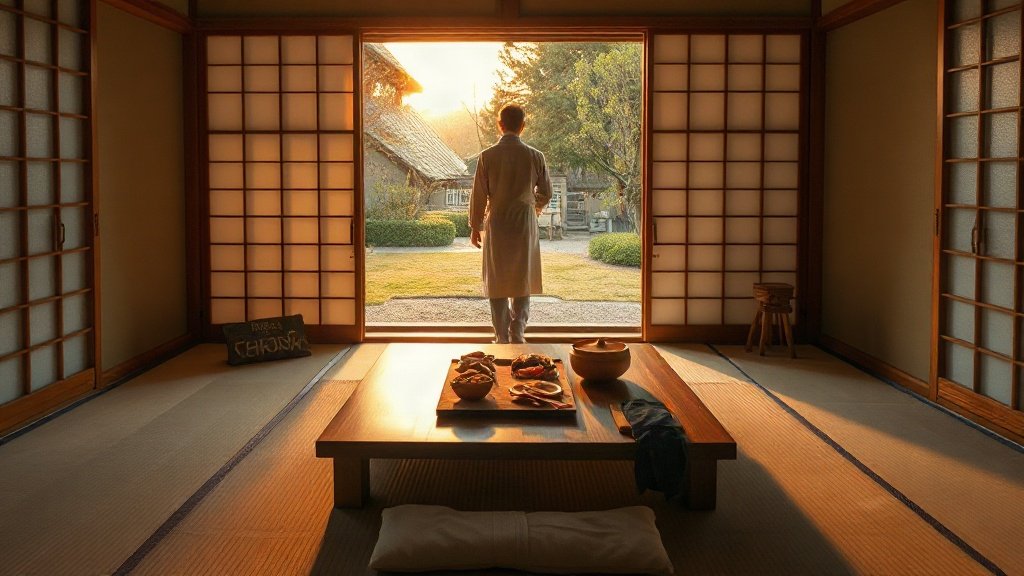
In short:
To reserve a traditional ryokan in Japan without committing an indip, validate your allergies upstream, arrive imperatively before 6:00 p.m. and respect the local label rules.
- Pricing per person: The price is calculated per occupant and includes half board (kaiseki dinner and breakfast).
- Strict arrival: A check-in between 3:00 p.m. and 6:00 p.m. is mandatory under penalty of losing dinner without refund.
- Additional taxes: Allow 150 JPY of bath tax per night in onsen, plus local tourist tax (up to 10,000 JPY in Kyoto).
- Code of conduct: Remove your slippers on the tatami mats, cross the yukata on the left side on the right side and shower before Lonsen.
How does the pricing of a traditional ryokan work?
A stay in the Ryokan is based on a very different economic and hotel model than Western hotels. The basic rule established by the Association of Ryokans and Hotels of Japan is that the rate is charged per person and not per room. This price systematically includes the overnight stay as well as the half-board, i.e. the traditional dinner (kaiseki) and the next day’s breakfast.
When calculating your overall budget, you must take into account the regulatory taxes to be paid on site:
- Consumption Tax (Shōhizei): A national tax of 10% applied on the overall amount of benefits (room and meals), set by the National Tax Agency of Japan.
- Bath tax (Nyūtōzei): A fee of 150 JPY per person per night, collected for establishments with thermal springs (ONSEN), according to the Ministry of Internal Affairs and Communication.
- Municipal tourist taxes: Variable depending on the city. In Tokyo, count 0 JPY for a room less than 10,000 JPY, 100 JPY from 10,000 JPY to 14,999 JPY, and 200 JPY from 15 000 JPY per night. In Osaka, the tax varies from JPY 200 to 500 JPY per night for overnight stays from JPY 5,000 (0 JPY below). In Kyoto, the city’s scale of 200 JPY (under 6,000 JPY) up to JPY 10,000 per person per night for exceptional rooms reaching or exceeding 100,000 JPY.
Checklist: the 6 steps to book error
Follow this chronological roadmap to secure your reservation and avoid the forced cancellation of your services on site.
| Step | Key action to perform | Strict rule or applicable tax |
|---|---|---|
| 1. Choice of dates | Check the cancellation policy | 20% to 50% costs between 2 and 5 days before, 80% the day before, 100% the same day. |
| 2. Meal reservation | Report allergies and diets beforehand | Mandatory when booking. No adjustments accepted at check-in or at the table. |
| 3. Transport planning | Schedule an arrival between 3:00 p.m. and 6:00 p.m. | Check-in after 6:00 p.m. leads to the cancellation of the Kaiseki dinner without refund. |
| 4. Check-in and registration | Present the original passports | Photocopy and entry of mandatory passport numbers according to Japanese law. |
| 5. Meals and Extras | Set drinks | Drinks (alcohols and sodas) served at Kaiseki are charged at check-out. |
| 6. Baths and thermal tax | Pay the Nyūtōzei tax | 150 JPY per person per night taken for access to thermal springs. |
How is the kaiseki meal going and what are the rules?
The Kaiseki dinner is the heart of the ryokan experience. It is a succession of several gourmet dishes made with seasonal products. According to the Japan Tourism Agency, the service is done on very strict slots, generally between 6:00 p.m. and 7:30 p.m., either directly in your room or in a dedicated dining room.
To ensure the smooth running of this meal, two elements are crucial:
- Allergy and diet management: All dietary restrictions (vegetarianism, shellfish allergies, gluten-free diets) must be transmitted during the initial booking. Due to the complexity of preparing Kaiseki cuisine, cooks categorically refuse last-minute modification requests made at the time of arrival or at the time of service.
- Beverage billing: Although the full meal is included in the half-board rate, drinks ordered during dinner (sake, beer, special teas, soft drinks) are subject to additional billing at the time of your departure.
What are the label rules to follow in the ryokan?
The reception in a ryokan obeys precise habits and customs which guarantee the preservation of the premises and the comfort of all the guests.
Entrance to the establishment and living in the room
As soon as you arrive at genkan (the entrance hall), you must remove your outdoor shoes to put on the slippers provided by the establishment. As soon as you enter a room covered with tatami, an absolute rule applies: you must remove your slippers from the outside of the room. On the tatami, you must walk exclusively barefoot or in socks.
A traditional cotton garment, the yukata, is available to you in your room. You can wear it to move around the whole property, including in the hallways and dining room. When dressing, scrupulously be sure to cross the left side of the garment on the right side. The reverse crossing (right side on the left side) is exclusively reserved for the traditional funeral ritual in Japan.
Use of hot baths and onsen
Access to the collective bath (ONSEN) requires strict compliance with several hygiene instructions recommended by the Japan Tourism Agency:
- Prior washing: You must imperatively carry out a complete body cleaning and rinsing with clean water at individual shower stations before immersing yourself in the collective bathing pool.
- Towel use: The small towel (tenugui) provided by the ryokan should never come into contact with pool water. Place it on the edge of the pool or fold it over your head while swimming.
- Tattoo regulations: The Japan Tourism Agency recommends that establishments accept tattoos if they can be masked by waterproof patches (maximum recommended size of 10 cm). For larger tattoos, it is advisable to Dopter for a ryokan offering a bookable private bath (Kashikiri Buro).
frequently asked questions
What happens if I arrive at the ryokan after 6 p.m.?
An arrival after 6:00 p.m. leads to the pure and simple cancellation of the Kaiseki dinner without the possibility of reimbursement, in accordance with the rules set by the Japanese Tourist Agency. Cooks prepare the fresh ingredients at specific times and cannot heat or postpone the service from the traditional menu.
How to pay tourist and bath taxes during your stay?
Nyūtōzei bath tax (150 JPY per person per night) as well as local tourist taxes (e.g. from 200 JPY to 10,000 JPY in Kyoto) are usually added to your final rating and Set on site during check-out at the same time as your extra drinks.
Is it possible to modify the Kaiseki menu once there?
No, last-minute adjustments at check-in or during the meal are systematically refused. All allergies and food restrictions must be declared at the time of prior booking in order to anticipate the order and the specific preparation of seasonal products.
{“@context”:”https://schema.org”,”@graph”:[{“@type”:”Article”,”headline”:”Comment réserver un ryokan au Japon : la checklist 2026″,”description”:”Checklist complète pour réserver un ryokan au Japon sans erreur : règles du kaiseki, horaire d’arrivée, étiquette de l’onsen et taxes obligatoires.”,”datePublished”:”2026-09-19″,”dateModified”:”2026-09-19″,”inLanguage”:”fr”,”keywords”:”reserver, ryokan, japon, etapes, reservation, check, list, checklist”},{“@type”:”FAQPage”,”mainEntity”:[{“@type”:”Question”,”name”:”Que se passe-t-il si j’arrive au ryokan après 18h ?”,”acceptedAnswer”:{“@type”:”Answer”,”text”:”Une arrivée après 18:00 entraîne l’annulation pure et simple du dîner kaiseki sans possibilité de remboursement, conformément aux règles fixées par l’Agence du tourisme du Japon. Les cuisiniers préparent les ingrédients frais à des heures précises et ne peuvent pas réchauffer ou différer le service du menu traditionnel.”}},{“@type”:”Question”,”name”:”Comment payer les taxes de séjour et de bain lors de son séjour ?”,”acceptedAnswer”:{“@type”:”Answer”,”text”:”La taxe de bain Nyūtōzei (150 JPY par personne et par nuit) ainsi que les taxes de séjour locales (par exemple de 200 JPY à 10 000 JPY à Kyoto) sont généralement ajoutées à votre note finale et réglées sur place lors du check-out en même temps que vos boissons extra.”}},{“@type”:”Question”,”name”:”Est-il possible de modifier le menu kaiseki une fois sur place ?”,”acceptedAnswer”:{“@type”:”Answer”,”text”:”Non, les ajustements de dernière minute au check-in ou durant le repas sont systématiquement refusés. Toutes les allergies et restrictions alimentaires doivent être déclarées au moment de la réservation préalable afin d’anticiper la commande et la préparation spécifique des produits de saison.”}}]}]}
