


Stay reachable, consult a live map, book a taxi or share your photos in real time: today, have a good Internet connection while traveling Has become almost as essential as having your passport. Gone are the days when you had to desperately look for an insecure public Wi-Fi network or pay exorbitant roaming fees when you return from vacation.
On aroundduglobe.fr, we tested all the methods to keep in touch all over the world. Between physical SIM cards and new dematerialized technologies, here is our comparison guide to choose the best option according to your traveler profile.
1. The different solutions to have network abroad
To maintain access to mobile data outside your national plan, several options are available to you:
- International roaming: Use your usual plan. Practical in the European Union thanks to the end of the adventurous costs, but extremely expensive as soon as you cross the borders of Europe.
- Pocket Wi-Fi (Pocket Wi-Fi) kiosks: Practical for groups or families, but they need to be recharged every day and represent an additional box to carry.
- The local physical SIM card: Buy a chip from an operator when you arrive at the airport or in the city.
- International LEIM: Activate a virtual chip in a few clicks directly from your smartphone, even before take-off.
To fully understand the significant differences between the purchase of a physical chip on site and the activation of a dematerialized package, you can consult this detailed article on the choice between Internet while traveling.
2. Why Lesim revolutionizes travelers’ lives?
leSIM (or built-in SIM) is a virtual chip already integrated in the majority of recent smartphones (iPhone, Samsung Galaxy, Google Pixel, etc.). It allows you to subscribe to a local or regional mobile data plan without having to handle the small plastic hatch on your phone.
There are many advantages:
- Time saving: No queue at the airport after a long flight to find a local SIM card.
- Enhanced security: You keep your French/European SIM card in your phone. You thus continue to receive your bank SMS (double authentication) on your usual number while using the data of your international plan.
- Simplicity: activation of a Internet connection with an eSIM is usually done by flashing a simple QR code received by e-mail.
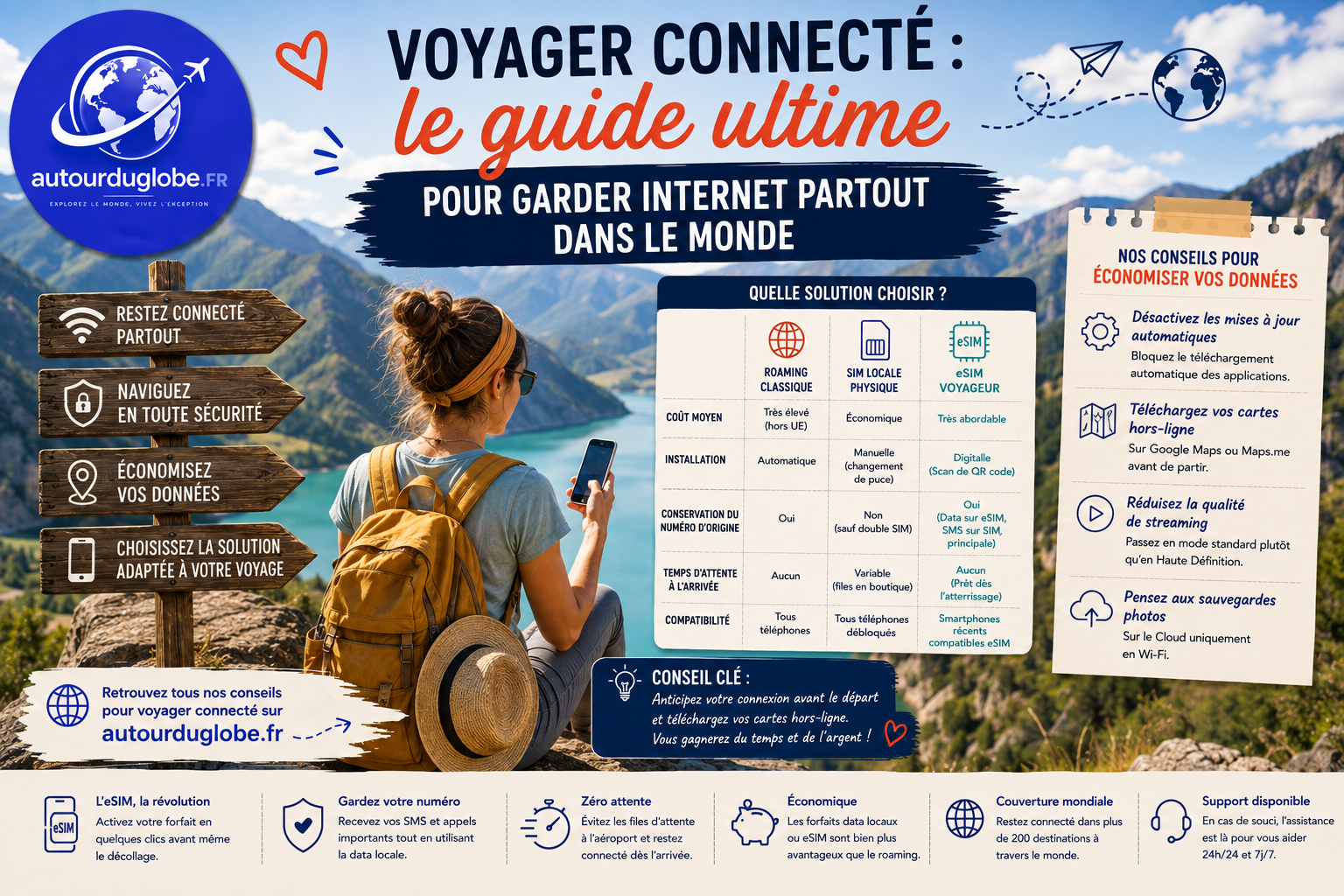
3. Comparative Table: Local SIM vs ESIM vs Roaming
To help you decide before your next departure, here is the summary of the key criteria:
| Criterion | Classic roaming | physical local sim card | Esim Traveler |
| average cost | Very high (excluding EU) | Economic | Very affordable |
| Installation | Automatic | manual (chip change) | Digital (QR code scan) |
| retention of the original number | Yes | No (except dual SIM phone) | Yes (Data on eSIM, SMS on main SIM) |
| Arrival waiting time | None | Variable (files in store) | None (Ready from landing) |
| Compatibility | All Phones | All phones unlocked | Recent eSIM compatible smartphones |
4. Our tips to save your travel data
Whichever solution you choose, data consumption can go very quickly if your smartphone is not well configured:
- Disable automatic updates: Block automatic downloading of apps and system updates on the cellular network.
- Download your offline maps: On applications like Google Maps or Maps.me, download the geographic areas of your destinations before you go.
- Reduce streaming quality: On video or music platforms, switch playback quality to standard mode rather than high definition.
- Consider photo backups: Configure the backup of your photos to the cloud (Google Photos, iCloud) for which only runs when you are connected to a Wi-Fi network.
