


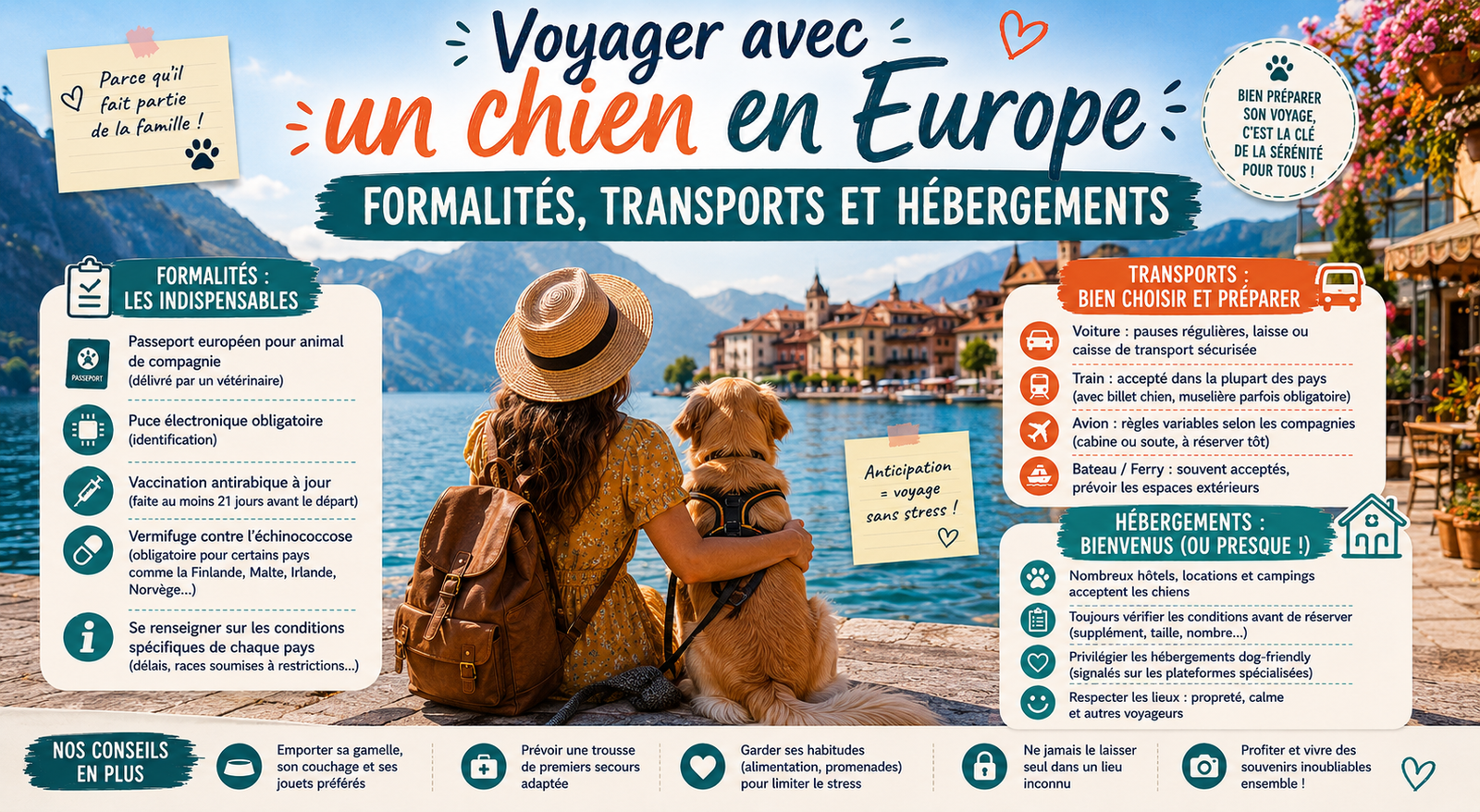
| In short : Crossing European borders with her four-legged companion is a wonderful adventure, greatly facilitated by the harmonization of the European Union. Some basics are still mandatory: – The European passport: Issued exclusively by a veterinarian, it is your dog’s official identity document throughout the trip. – The administrative trilogy: Identification by microchip, vaccine against valid rabies (performed after the installation of the chip), and specific deworming treatment for certain island destinations. – Various canine cultures: The reception varies from country to country. If Germany and Austria open wide the doors of their restaurants to dogs, the beaches of southern Europe impose much stricter regulations in summer. |
Go on vacation without your dog? No way! A true member of the family, your favorite truffle also has the right to discover new horizons. Traveling to Europe with an animal is one of the simplest and most reassuring options, but it doesn’t make sense at the last minute.
On aroundduglobe.fr, we test European roads from every angle. From health rules essential to transport tips and accommodations dog friendly, here is your complete roadmap for a European stay without false note and without stress.
1. Administrative formalities: the legal checklist
To move freely within the European Union (and in the Schengen area), your dog must imperatively be in good standing with Community legislation.
European pet passport
This is his unique official document. This standardized blue notebook is provided and completed by your veterinarian. It gathers its identification information and the history of its vaccines. Remember to ask for it several weeks before departure.
Electronic chip and rabies vaccine
Your dog must necessarily be identified by a microchip (The tattoo is only tolerated if it was made before July 2011 and remains perfectly readable). second absolute imperative: the rabies vaccine (against rage). Attention to the schedule: during a first vaccination, it is only considered valid after a period of 21 days. Don’t be surprised just before crossing the border!
2. Transport: how to get around together?
The choice of your mode of transport will greatly impact the comfort of your pet.
The car: total freedom
The road trip remains the ideal solution. Your dog is in his familiar environment and you manage the breaks (every two hours minimum) as you see fit. European legislation requires that the animal does not interfere with the visibility of the driver: use a fixed transport box or a safety harness connected to the belt buckle.
The train: practical but regulated
The majority of European railway companies (SNCF, Deutsche Bahn, Trenitalia) accept dogs. Small dogs in a basket often travel for free or for a symbolic sum. For large dogs, they must be kept on a leash, muzzled, and require the purchase of a specific ticket (often equivalent to 50% of a second-class ticket).
Watch out for special destinations! If you plan to go to United Kingdom, Ireland, Malta or Finland, your dog must receive treatment for tapeworm (Echinococcus), administered by a veterinarian and recorded in the passport between 24h and 120h before the precise time of entry into the country.
Comparative table: What reception for your dog depending on the country?
Culture dog friendly varies greatly from north to south of Europe. Anticipate local habits with our summary.
| European destination 🌍 | Access to restaurants & Coffees 🍔 | Access to natural areas & Transport 🌳 | Overall rating ⭐ |
| Germany / Austria | Excellent. We often bring a water bowl to your dog before even taking your order. | Very good. Accepted everywhere in urban parks and trains (with option ticket/museum). | ⭐⭐⭐⭐⭐ (Canine Paradise) |
| Italy | good. Very well tolerated on the terrace and often accepted indoors if the dog is calm. | Average. Public beaches are often prohibited for dogs in summer, aim for the dedicated “Bau Beach”. | ⭐⭐⭐⭐ (very welcoming) |
| France | correct. On a case-by-case basis depending on the manager’s mood, always ask politely at the entrance. | variable. Prohibited in the majority of national parks (to protect wildlife), but well accepted on trains. | ⭐⭐⭐ (medium) |
| Spain / Portugal | Quite limited. Indoor access remains rare, systematically favor outdoor terraces. | restrictive. Urban public transport is sometimes closed to large dogs. highly regulated natural parks. | ⭐⭐ (requires organization) |
FAQ: Your logistical questions for a serene holiday
1. How to easily find accommodations that accept dogs?
On large platforms (Booking, Airbnb), systematically check the filter “Pets allowed”. However, do not stop there: always contact the host after reservation to specify the size of your dog. Some establishments display “admitted” but limit access to dogs of less than 10 kg, or apply a lump sum per night (count between 5€ and 15€ on average).
2. Can I fly with my dog for a short stay in Europe?
It is possible but stressful. If your dog is less than 8 kg (bag included), he can usually travel with you in the cabin to regular companies (low-cost companies like Ryanair categorically refuse animals). Beyond this weight, he will have to travel in the hold in an IATA approved crate. Except in cases of force majeure, always favor the train or the car to spare this stress.
3. What if my dog gets sick while on vacation abroad?
Do not panic, European veterinary medicine is excellent. Just remember to bring your basic first aid kit (flea, tick, compress, disinfectant) and its usual treatment if necessary. In an emergency, look for a “Clinica Veterinaria” or a “Tierarzt” On Google Maps. The European passport being written in English and in the language of the country of origin, the local practitioner will immediately understand his medical history.
