


The Haute-Corse has this rare talent to offer everything in a few kilometers: a citadel that watches over the sea, eagle-nest villages, clear coves like spring water and trails that smell of maquis. Here is a week cut to take the pulse of the north of the island, with busy days, stops that matter and small detours that change everything.
Day 1 – Calvi, wide angle material
We start with Calvi, a postcard that really lives. Downstairs, along the quay Adolphe-Landry, the terraces look at the boats; At the top, the Genoese citadel (XIIIᵉ) unrolls its cobbled streets to the Saint-Jean-Baptiste Cathedral. Take a jump at the Sainte-Marie-Majeure church, all in baroque curves, then at the covered market (open in the morning, 8 a.m. – 12:30 p.m.) to fill the basket: charcuterie, cheeses, olive oil… The best fuel for the future. In the afternoon, go barefoot on the large beach hemmed with pine trees: five kilometers of sand facing the citadel, a decor impossible to forget. At sunset, climb towards Pointe Saint-François: the fortress ignites, the bay is golden, and you then understand the whole meaning of these Holidays in Corsica.

Day 2 – Cliffs and lookouts: Revellata, Serra, Spanu
Head west of Calvi for a loop to the La Revellata lighthouse: around 9 km A/R on a coastal path, wild coves and golden rocks on the program (count 3 quiet hours, hat and rigorous water). Going up, stop at Notre-Dame-de-la-Serra: the chapel overlooks the bay and the mountains; The Madonna statue, replaced in 2023 after lightning, watches over Calvi as a mother hen. Finish on the side of Punta Spanu, a promontory sculpted by the wind punctuated by small coves: polished rocks, Genoese tower and “end of day” swimming which are worth a nap.
Day 3 – La Balagne Perchée: Villages of character
place in Balagne, “Jardin de la Corsica which aligns villages suspended above the sea. Sant’Antonino (500 m altitude) is explored to the rhythm of the vaulted passages and tight stairs; At the top, a 360° swallows valleys and Mediterranean. In Pigna, push the doors: luthiers, potters and craftsmen work in the shade of the blue shutters, ideal for a memory that makes sense. Corbara, in the amphitheater, unrolls its large baroque church towards the sea, while Aregno hides a Romanesque jewel in the Trinity. Take the time to get lost: here, the right photo is often at the next angle.
Day 4 – Île-Rousse and Pocket Beaches
Urban morning at Île-Rousse: pedestrian streets, clear facades and covered market with 21 columns (open all day in season), perfect for a picnic just a stone’s throw from the beach with clear sand and shallow water. Slip to Algajola for the charm of a seaside town, then choose your duo of beaches: Ghjunchitu (parking spotted along the road, small walk through the maquis) and Bodri, connected by a path coastal. Here, the palette goes from milky to turquoise, and we quickly understand why some never exceed Balagne.

Day 5 – Scandola & Girolata: the “Wow” day
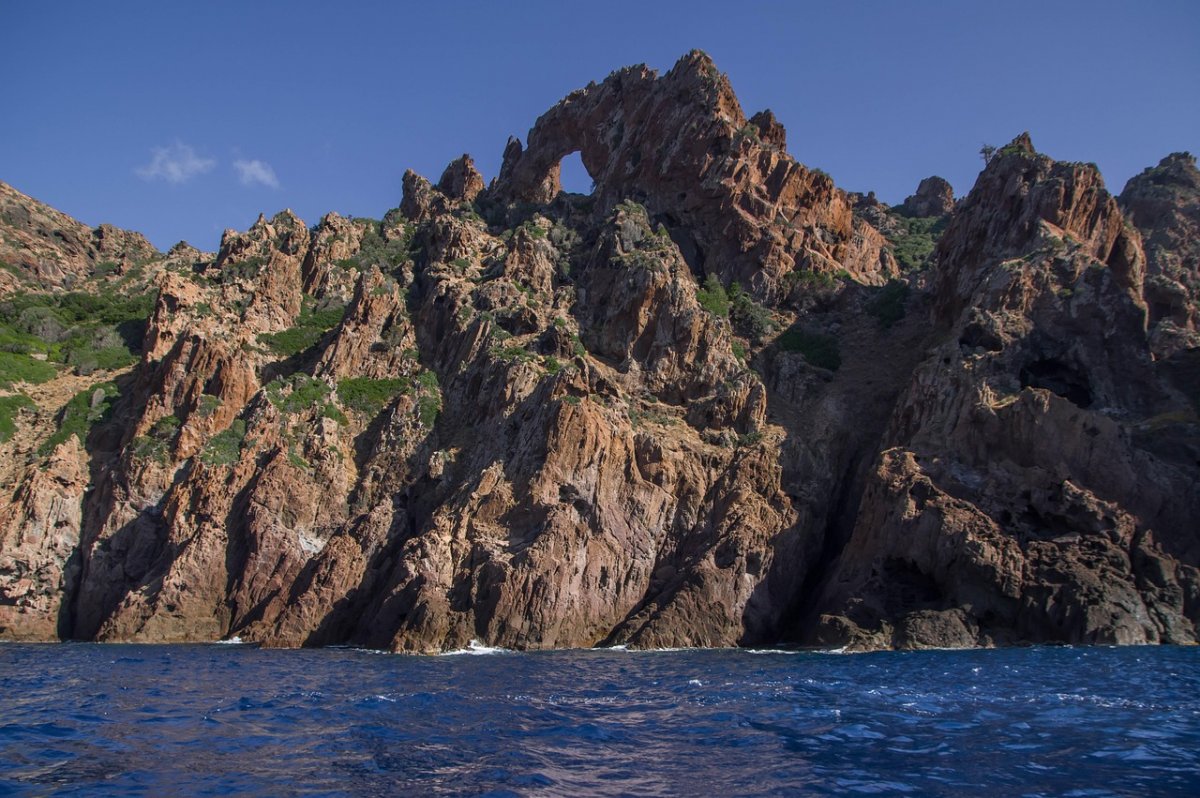
As soon as the weather is good, head for the Scandola nature reserve: red granite cliffs classified by UNESCO, caves, arches… In season, boat trips from Calvi offer the best reading of the reliefs; Out of season, the alternative is royal: the “path of the postman” towards Girolata. From the Bocca a Croce car park, count approx. 10 km A/R (≈ 3 h, D+ 350 m). We descend on Tuara Bay, then a balcony above the sea drops you off on the village, accessible only on foot or by boat. For the return, the Mare e Monti variant (orange markup) goes up in the maquis, less steep but a little more physical. On the beach, don’t be surprised if a few cows ruminate in front of the waves: here, even they take a vacation.

Day 6 – Galeria and the Fango Valley: the island on the river side
Change element: in Galeria, a short path leads to the Fango Delta, with a magnificent view of the mouth and the wild beach of Ricciniccia, in a site classified as a biosphere reserve. Upstream, the Fango valley aligns basins and emerald waterfalls: from Ponte Vecchiu, a pleasant path (≈ 4 km to Tuarelli) runs along the river, perfect for a walk punctuated by fresh water baths when it is hot. It is the “feet in the water” parenthesis that balances the week.
Day 7 – Saint-Florent & Les Agriates… or heading for Nonza and Bastia
Two finals, two atmospheres.
Option 1 : Saint-Florent, dapper port at the foot of a citadel, compulsory terrace to look at the alleys on the quays. By the track (or by boat in summer), reach the beaches of Lotu and Saleccia; Otherwise, walk a portion of the customs trail from Fornali to La Mortella Tower (A/R ≈ 12 km easy). Tip: At Fiume Santu, we cross a stream of calves in the water – pleasant in warmth, refreshing the rest of the time. At the exit of the desert, the Ostriconi unrolls a wild lagoon framed by dunes: one of the most beautiful sand-sea views in the region.
Option 2 : draw a line on the Corsican heading. Nonza, perched 150 m above a huge beach of black pebbles, offers a breathtaking panorama from the Paoline tower; The beach, shaped by mining discharges in the 20th century, intrigues as much as it impresses (more than 500 steps to descend). End of the day in Bastia: Citadel of Terra Nova, old port, lively squares – an Italian-style dolce vita that makes you want to extend.

Revellata, Scandola, Agriates: the winning duo Calvi–Saint-Florent
Base yourself twice rather than once: three/four nights around Calvi to shine on Balagne, Revellata and Scandola; Then two/three nights towards Saint-Florent for the Agriates and, if you feel like it, a hook towards Nonza and Bastia. This avoids long daily shuttles and leaves time for real breaks.
The car remains the ideal ally: splendid but “playful” roads, we plan for it and we embrace the slow-travel. On the season side, May-June and September-October are perfect (pleasant sea, mild temperatures, comfortable hikes); At the very end of October, some restaurants and hotels are lowering the curtain, especially by the beach: anticipate for evening meals.
For the table, rely on short cards and local products (brocciu, veal, fish); In Calvi, you can find good addresses from the Bistrot de Port to the wood-fired pizza trattoria, and even a local canteen to taste canistrelli, zucchini fritters or a canistrelli tiramisu – enough to please everyone without leaving his purse there.
This route does not stack “spots”, it tells a week when each day has its color: the ocher of Scandola, the pale blue of the beaches of Balagne, the green of the fango, the silvery gray of the pebbles of Nonza. Take the time to look up, chat with the craftsmen, taste what simmers and change the plan if the light is more beautiful elsewhere: in Haute-Corse, it is often the small fork that becomes your best memory.
