


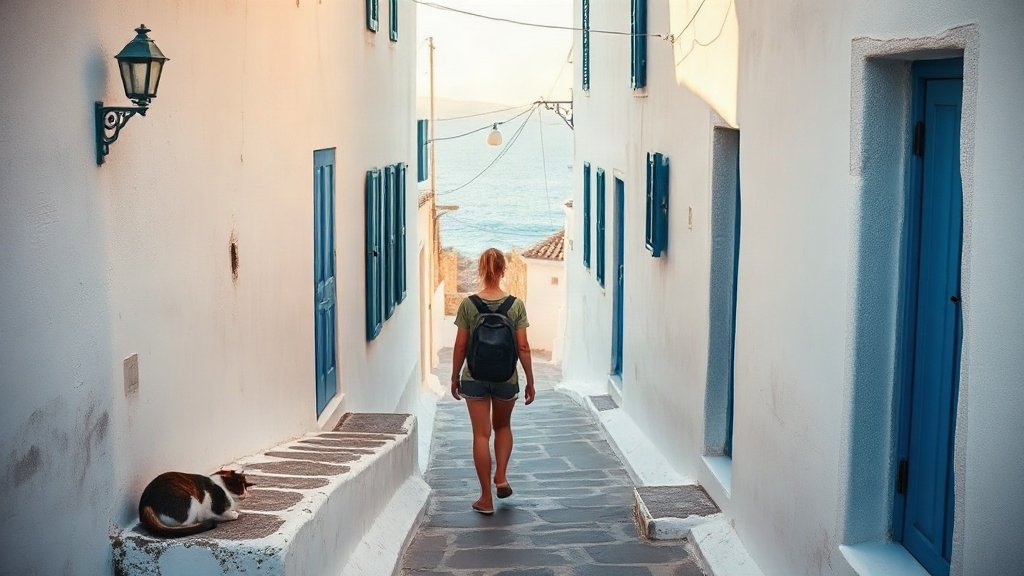
In short: the Greek islands preserved from massive tourism
To escape the hustle and bustle in Greece this year, favor the small islands of the Cyclades and the low hotel capacity Dodecanese.
- Exclusion criterion: Avoid Santorini and Mykonos, which have 220 and 200 tourists respectively per permanent inhabitant year-round according to LELSTAT.
- Strict regulation: Favor islands like Sikinos, where the local planning plan limits hotels to 20 beds maximum per establishment.
- Accessibility: Choose destinations without international airport, accessible only by direct ferry from Piraeus or via local connections.
- Formalities 2026: For LU nationals, a valid ID card is sufficient. A climate resilience tax applies to accommodation throughout Greece.
How to choose an authentic and uncrowded Greek island?
The Aegean-South region has 127.2 tourist overnight stays per permanent inhabitant According to Eurostat, the highest rate in the entire European Union. This figure rises to 102.6 overnight stays in the Ionian Islands. To find tranquility, you have to observe the proportion of the local hotel offer and the absence of mass infrastructure such as cruise terminals.
The Greek government now applies a tax of €20 on cruise ship passengers arriving in Santorini and Mykonos during the high season (from June to September). At the same time, the law limits to 100 beds maximum any new hotel construction in so-called saturated areas. To live a preserved Greek experience, the secret lies in the choice of islands that have preserved strict urban planning thresholds.
| Island or region | Tourism pressure (Eurostat / Elstat) | Planning & Capacity |
|---|---|---|
| South Aegean (average) | 127.2 overnight stays / inhabitant | Variables depending on the island |
| Ionian Islands (average) | 102.6 overnight stays / inhabitant | 150 nights / resident in Zakynthos |
| Santorini | 220 tourists/inhabitant (15,500 inhab.) | New hotels limited to 100 beds max (saturated area) |
| Mykonos | 200 tourists/inhabitant (10,704 inhab.) | New hotels limited to 100 beds max (saturated area) |
| sikinos | Low tourist pressure (~200 inhab.) | Maximum 20 beds per hotel |
| anafi | Very low tourist pressure (293 inhab.) | Area of 40.37 km², absence of large complex |
| lipsi | Very low tourist pressure (~700 inhab.) | Area of 16 km², moderate development |
Ranking of the 5 Greek islands still preserved in 2026
This classification retains inhabited islands all year round where local regulations and geography hinder the development of industrial tourism.
1. Sikinos (Cycles)
Verdict: Sikinos is the most rigorous island of the Cyclades when it comes to regulating tourist buildings.
Sikinos has about 200 permanent inhabitants according to the municipality. The local urban development plan sets a strict ceiling of 20 beds maximum per hotel establishment. This rule prevents the establishment of international chains and guarantees total immersion in village life. The island can be visited mainly on foot along well-marked mulete trails linking Chora to the small port Dalopronoia.
2. Anafi (Cyclades)
Verdict: The ideal island for absolute dislocation, located in the extreme south of the Cyclades.
With only 293 permanent inhabitants spread over a total area of 40.37 km² (Elstat data), ANAFI offers considerable space per visitor. Located in the east of Santorini, it does not undergo any tourist waves due to less frequent maritime connections. Its impressive relief culminates with the rock of Kalamos, the second largest monolith in the Mediterranean after Gibraltar.
3. Lipsi (dodecanese)
Verdict: A 16 km² nugget preserved from mass infrastructure.
The inhabited island of Lipsi brings together about 700 inhabitants in a restricted territory of 16 km². Lipsi made the deliberate choice to refuse mega-infrastructure projects and the creation of cruise ship ports. It is easy to walk there on foot or by scooter between the main village and the small coves bordered clear waters.
4. Schinoussa (Small Cyclades)
Verdict: Absolute tranquility in the heart of the small Cyclades archipelago.
Accessible by classic ferry or via the local Express Skopelitis ferry from Naxos, Schinoussa seduces with its peaceful pace. The island does not have major highways and is easily crossed on foot. Small harbors and family taverns operate there without the frenzy of larger neighboring islands.
5. Kimolos (Cyclades)
Verdict: An authentic alternative to its neighbor Milos, famous for its crafts and whitewashed villages.
Separated from Milos by a narrow arm of the sea, Kimolos maintains a traditional island atmosphere. Its main village, Chorio, is home to quiet alleys and local accommodation. The absence of an international airport naturally filters traveler flows, guaranteeing remarkable tranquility even during the summer months.
What formalities and what budget to plan to travel to the islands in 2026?
The trip to the Greek Islands does not require a visa for citizens of the European Union, Switzerland or Canada for short stays. The valid identity card or passport is sufficient. Euro is the official currency used throughout the territory.
The Greek state raised 588 million euros thanks to the climate resilience tax on accommodation. This tax, levied directly by hoteliers and room rental companies, varies according to the category of your accommodation and the season. Remember to include it in the estimation of your costs on site.
For transport, favor ferry connections reserved in advance during the summer period. The crossing from the port of Piraeus to the remote Cyclades lasts several hours by conventional ferry, which contributes to preserving the tranquility of these isolated destinations.
frequently asked questions
Which Greek island to choose to avoid mass tourism?
Sikinos, Anafi and Lipsi are among the most effective choices. They impose strict limits on hotel constructions and do not have international airports or ports for cruise ships, which maintains very moderate attendance throughout the year.
What are the regulations on hotels in the preserved islands?
Some islands apply strict local town planning rules. For example, Sikinos limits the capacity to 20 beds maximum per hotel. Conversely, in saturated areas such as Santorini and Mykonos, the condition peaks at 100 beds.
What tourist taxes apply in Greece in 2026?
Greece charges a climate resilience tax on overnight stays in tourist accommodation, having generated 588 million euros. In addition, a tax of €20 applies to cruise ship passengers arriving in Santorini and Mykonos between June and September.
{“@context”:”https://schema.org”,”@graph”:[{“@type”:”Article”,”headline”:”Îles grecques préservées en 2026 : 5 escales hors du tourisme”,”description”:”Découvrez les îles grecques les moins touristiques en 2026. Un classement pragmatique basé sur la densité hôtelière et la fréquentation réelle.”,”datePublished”:”2026-09-06″,”dateModified”:”2026-09-06″,”inLanguage”:”fr”,”keywords”:”iles, grecques, preservees, tourisme, listicle”},{“@type”:”FAQPage”,”mainEntity”:[{“@type”:”Question”,”name”:”Quelle île grecque choisir pour éviter le tourisme de masse ?”,”acceptedAnswer”:{“@type”:”Answer”,”text”:”Sikinos, Anafi et Lipsi figurent parmi les choix les plus efficaces. Elles imposent des limites strictes aux constructions hôtelières et ne disposent pas d’aéroports internationaux ni de ports pour navires de croisière, ce qui maintient une fréquentation très modérée tout au long de l’année.”}},{“@type”:”Question”,”name”:”Quelle est la réglementation sur les hôtels dans les îles préservées ?”,”acceptedAnswer”:{“@type”:”Answer”,”text”:”Certaines îles appliquent des règles d’urbanisme locales strictes. Par exemple, Sikinos limite la capacité à 20 lits maximum par établissement hôtelier. À l’inverse, dans les zones saturées comme Santorin et Mykonos, l’État plafonne les nouvelles constructions à 100 lits.”}},{“@type”:”Question”,”name”:”Quelles taxes touristiques s’appliquent en Grèce en 2026 ?”,”acceptedAnswer”:{“@type”:”Answer”,”text”:”La Grèce préélève une taxe de résilience climatique sur les nuitées en hébergement touristique, ayant généré 588 millions d’euros. De plus, une taxe de 20 € s’applique aux passagers de navires de croisière arrivant à Santorin et Mykonos entre juin et septembre.”}}]}]}
