


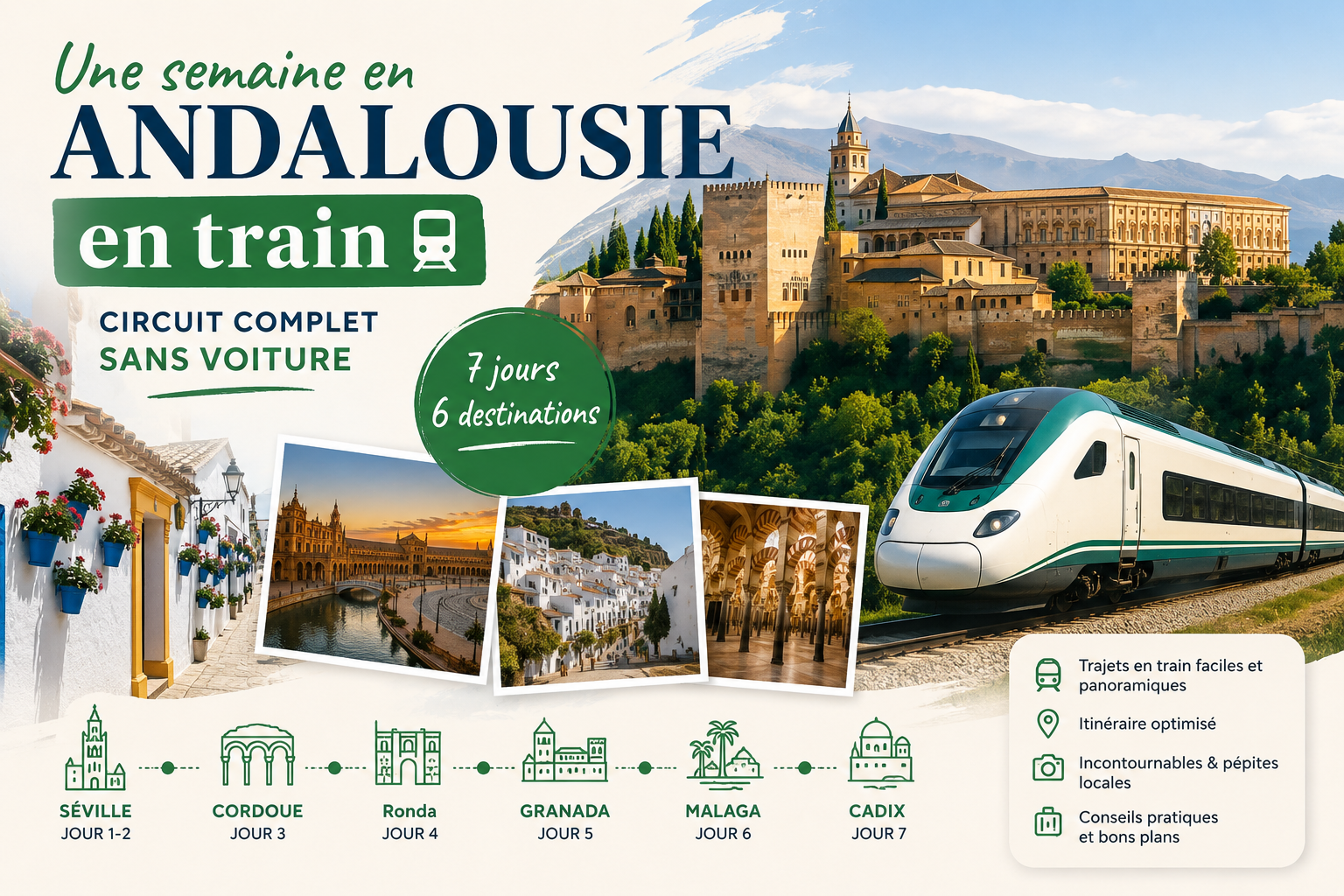
| In short : Do you dream of discovering the south of Spain without the constraints of the road? Here’s what to remember from our one-week route to Andalusia by train: – Ideal duration: 7 full days to explore the Andalusian golden triangle. – Stage cities: Seville, Cordoba and Granada, interconnected by the high-speed rail network (RENFE AVE). – Zero car: An eco-responsible trip, without parking stress or urban traffic jams. – Essentials: Visits to Lalcazar, the mosque-cathedral and the mythical Alhambra. – Simplified logistics: Central stations perfectly connected to local public transport networks (subway, bus). |
Andalusia instantly evokes the sweetness of life, the bewitching rhythm of flamenco, colorful azulejos and centuries-old architectures unique in the world. However, the idea of renting a car, venturing into the narrow historical streets of Seville or looking for overpriced parking in Granada can quickly slow down enthusiasm. Fortunately, the Spanish rail network is among the best performing in Europe. Travel A week in Andalusia by train is not only feasible, but it is the assurance of a serene, fast and environmentally friendly stay.
This tour guides you through the Andalusian golden triangle: Seville, Cordoba and Granada. Follow the guide for a memorable trip from station to station.
Day 1 to 3: Seville, Leffervescent Andalusian capital
Your adventure begins at the Seville Santa Justa Station, major railway center connected directly to Seville airport (SVQ) by the EA bus line, or accessible in less than 2h30 from Madrid via the AVE high-speed train.
The arrival and immersion in the Santa Cruz district
After dropping off your luggage, head to the historic heart. the district of Santa Cruz, a former Jewish quarter, is a labyrinth of whitewashed alleys, flowering patios and squares shaded by orange trees. Strolling on foot is a pure enchantment. At the end of the day, head to the majestic Plaza de España, architectural masterpiece in a semicircle, ideal for admiring the glow of the sunset reflected on its canals.
Major architectural treasures
Devote your second day to the combined tour of the Seville Cathedral, surmounted by its famous tower of the Giralda, and the masterpiece Mudéjar: the Real Alcazar. These monuments being within walking distance of each other, the car is totally useless. For your evening, book an authentic flamenco show in the district of Triana, the cradle of this art, on the other side of the Guadalquivir river.
Day 4: Cordoba, the crossroads of cultures
On the morning of the fourth day, board a train from Seville-Santa Justa Ave. In just 45 minutes of all comfort, you get off at the Cordoba Station (Cordoba Central). The transition is absolutely fluid.
The Mosque-Cathedral (Mezquita) and the Judería
From the station, a pleasant 15 minute walk through the Victoria Gardens leads you to the legendary Mosque-Cathedral of Cordoba. This unique monument in the world fascinates with its two-tone horseshoe forest and the Christian cathedral erected in its center. Continue your exploration in the Juderia, the historic center of Cordoba, famous for its Calleja de las Flores (The Lane des Fleurs) and its traditional patios, listed as World Heritage by UNESCO. A single day is enough to imbue the peaceful atmosphere of this city before leaving.
Day 5 to 7: Grenada, the pearl of the Sierra Nevada
At the end of the afternoon of day 4 or in the morning of day 5, take the front axle or lava linking Cordoba to the Granada Station (Granada) In about 1h35. The railway route crosses spectacular landscapes of olive groves as far as the eye can see.
Lalhambra, Nasride art summit
Spain’s most visited monument requires rigorous planning: book your tickets for thealhambra and the Nasrid Palaces several months in advance. Nestled on its hill, Lalhambra is easily accessible from the city center using the red minibuses from the local network (C30 or C32 lines), thus avoiding any tedious walking uphill.
Lalbaicín and the Sacromonte
lose yourself in thealbaicin, the oldest Moorish district in the city. its climbing streets will lead you to the Mirador de San Nicolás, offering the most famous panorama on the Alhambra with, in the background, the snowy peaks of the Sierra Nevada. Extend the walk to the neighboring district of sacromonte, renowned for its troglodyte dwellings and the history of its gypsy communities.
Expert advice: For the purchase of your train tickets in Spain, choose the official website of the enfe or certified comparison platforms like Trainline. Buying your tickets several weeks in advance guarantees you the best prices (promo or básico rates) and the insurance to have a seat on the high-crowded lines.
Logistic summary of your Andalusian train circuit by train
| Stage / Journey | Type of train | Average duration | Daily frequency |
| Seville — Cordoba | AVE / Avant | 40 to 45 min | More than 25 departures |
| Cordoba — Granada | AVE / Avant | 1h35 to 1h45 | About 4 to 6 direct departures |
| Granada — Sevilla (Back) | Before | 2h30 | About 4 direct departures |
FAQ: Traveling to Andalusia without a car
1. Are Andalusian stations close to historic city centers?
Yes I do. In Cordoba and Granada, the train stations are about 15-20 minutes walk from the historic areas, and are perfectly served by local buses. In Seville, Santa Justa Station is about 20 minutes walk from the Santa Cruz district or accessible in a few minutes by bus (lines 21, 32) or taxi for less than 10€.
2. Is it mandatory to book your train tickets in advance?
It is strongly recommended to book in advance for high-speed trains (AVE and AVER), especially on the Cordoba-Grenada axis where the number of direct daily connections is more limited. In addition, prices rise as the departure date approaches.
3. How to get around inside cities without a car?
The public transport network in Andalusia is excellent. Seville has a metro line and an extensive bus network. Granada has a light metro and essential urban minibuses to get on to Lalbaicín or Lalhambra. Cordoba can be visited almost exclusively on foot.
4. When is the best time to complete this circuit?
Spring (April to June) and Autumn (September to November) are the ideal seasons. You will avoid the extreme heat of Andalusian summer (which often exceed 40°C in Seville and Cordoba) while enjoying perfect brightness for the photo.
