


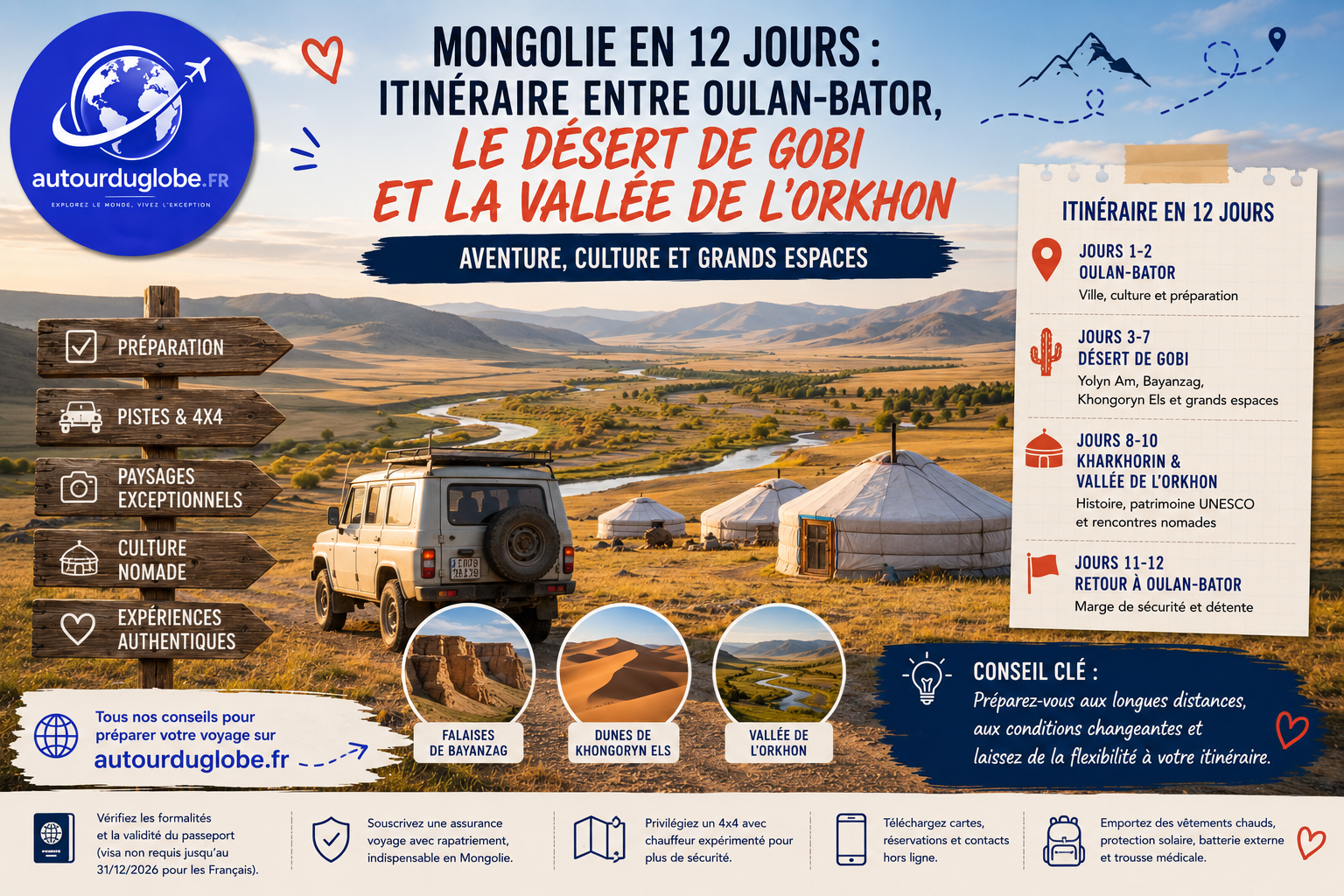
Mongolia attracts by its infinite horizons, its yurt camps and a nomadic culture still very present. However, it cannot be visited as a destination where you can easily chain steps. The distances are considerable, many roads become tracks and services remain rare far from the cities. A twelve-day circuit makes it possible to associate Ulaanbaatar, the Gobi desert and the Orkhon valley, provided you accept long days of travel and a flexible program.
Before departure: formalities and organization
At the date of writing, French tourists can stay in Mongolia for up to thirty days without a visa, as part of a measure scheduled until December 31, 2026. The regulations must nevertheless be verified before departure. France Diplomatie also recommends insurance covering care and repatriation, which is particularly important in a country where medical structures are limited outside the capital.
For a first trip, booking a vehicle with a driver is generally more reasonable than renting a car independently. The indications are rare, the tracks are divided without signage and their condition depends on the weather. The official Go Mongolia site specifies that an SUV or a 4×4 is necessary for many trips outside Ulaanbaatar, in particular to the Gobi.
Days 1 and 2: Take your bearings in Ulaanbaatar
The capital is the gateway to the country and the best place to prepare for the circuit. The first day can remain light: installation, change, purchase of provisions and walk around the central square. The traffic being often dense, it is better to group the visits by district.
The second day can be devoted to the monastery of Gandantegchinlin, the national museum and the markets. This step also allows you to check the reservations, download the necessary documents and complete the equipment. In isolated regions, it will not always be possible to quickly find a medicine, a battery or a suitable garment.
Days 3 to 7: Discover the Gobi Desert
The departure to the south marks the beginning of the journey on the slopes. The Gobi is not only a sea of dunes: it alternates mineral plains, cliffs, rock reliefs and dry steppe areas. The official Mongolian tourist promotion site presents it as one of the emblematic landscapes of the country.
Over five days, a route may include Dalanzadgad, Yolyn Am Gorges, Bayanzag Cliffs and Khongoryn Els Dunes. However, you should avoid considering each step as a quick visit. Much of the experience is about the journey, impromptu stops and light changes. These three sites are among the main experiences recommended in the Gobi by the Mongolian Tourist Office.
The nights often take place in camps in Gers, the Mongolian term translates as “yurts”. Comfort varies: some camps have private toilets, others common facilities and a limited power supply. A headlamp, an external battery and a small bag for the night are therefore useful.
Temperatures can change quickly. Even during the beautiful season, a hot day can be followed by a cool evening. It is better to superimpose the clothes than to rely solely on the temperature announced in the capital.
Days 8 to 10: Kharkhorin and the Orkhon Valley
After the arid landscapes of the South, Central Mongolia offers a marked contrast. Kharkhorin allows you to approach the history of the ancient Mongolian Empire and visit the monastery of Erdene Zuu. The city is located in the cultural ensemble of the Orkhon Valley, listed as a World Heritage Site.
According to UNESCO, this landscape brings together vast pastures, archaeological remains and the traces of successive political, commercial and religious centers. The valley also remains a space of nomadic pastoralism, which gives it both historical and lively interest.
Two or three days allow you to travel the surroundings, to reach a waterfall depending on the condition of the slopes and to spend a night in a family or tourist camp. Movements must remain flexible: after heavy rains, some passages can be slowed down.
When visiting a family, wait for the host’s directions before sitting, photographing or touching objects. An attentive attitude counts more than mastering all customs.
Days 11 and 12: Return without planning a tight match
The return to Ulaanbaatar must include a margin. The track conditions, traffic at the entrance to the capital or a mechanical problem can lengthen the journey. It is imprudent to arrive from the Orkhon valley just hours before an international flight.
The last day is used to rest, buy some souvenirs and absorb a possible delay without calling into question the return.
Mobile connection and offline navigation
A mobile connection remains useful for contacting accommodation, consulting a reservation or notifying a driver. However, it should never be the only steppe navigation solution. Before buying a plan, compare your operator’s roaming, a local SIM card and a Esim for Mongolia.
Travel Data Kit indicates that Mobicom generally offers the most consistent 4G coverage in provincial centers and on classic tourist routes. The site, however, points out that the remote steppe, the desert, mountain valleys and many national parks may have irregular or non-existent coverage.
Install the eSIM before the flight if you choose this solution, then keep its QR code and instructions offline. Also download Mongolia maps, campsite GPS coordinates, reservations and emergency contacts. A hard copy of the route remains useful when the phone is unloaded or no signal is available.
What to take?
A warm, windproof jacket, superimposable clothing, sun protection, a water bottle and a small medical kit are a reasonable basis. Add an external battery, a headlamp and a bag protecting devices from dust.
France Diplomacy discourages night driving and recalls that the distance, the state of the road network and the weakness of medical structures justify reinforced vigilance throughout the country. So communicate your itinerary, keep the contact details of the insurance and do not leave a camp alone without warning.
Travel slowly to better understand Mongolia
Twelve days do not allow you to see all of Mongolia. However, they are enough to discover three complementary dimensions: the urban life of Ulaanbaatar, the mineral landscapes of the Gobi and the pastoral heritage of the Orkhon valley.
The success of the trip depends less on the number of places checked than on the quality of the organization. By planning an experienced driver, realistic stages, offline maps and a margin before the return flight, we take full advantage of a destination where the journey is part of the experience.
